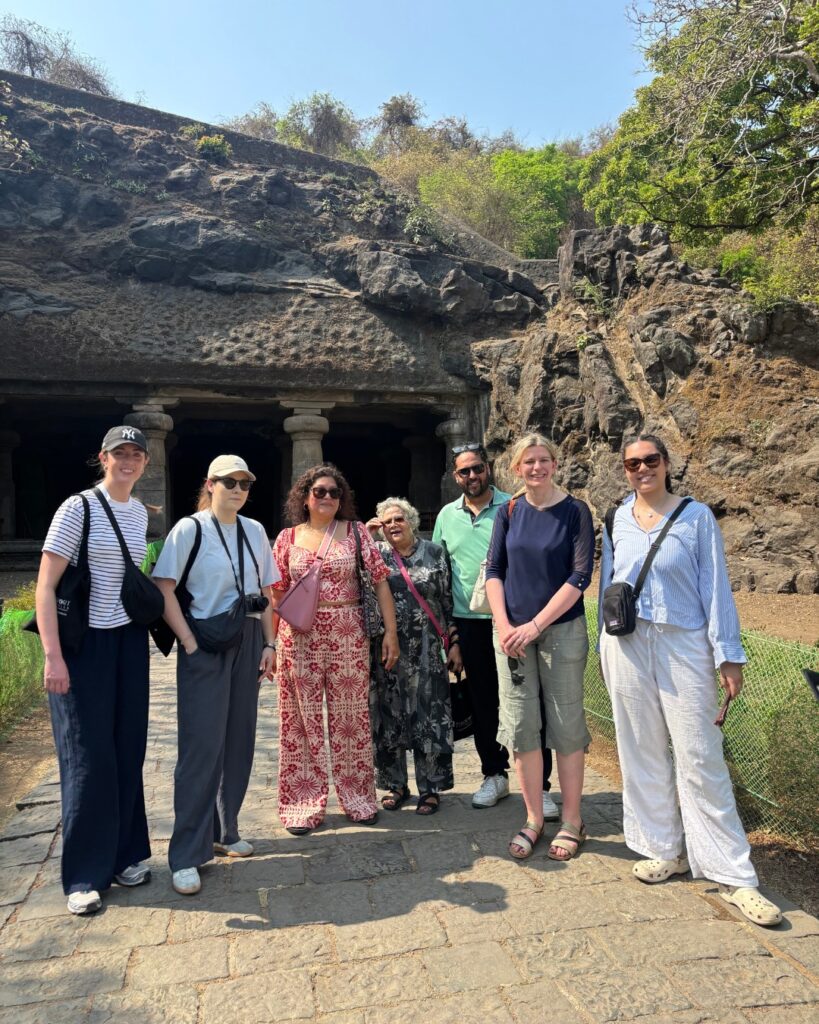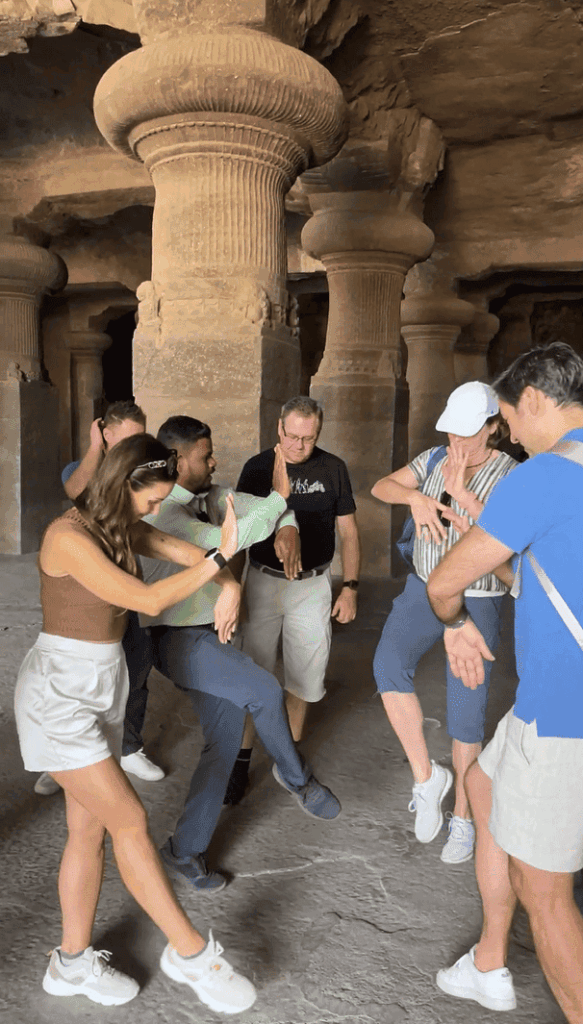
A short journey across Mumbai Harbour leads to one of the city’s most remarkable heritage sites: Elephanta Island.
Known historically as Gharapuri, the island is home to the UNESCO World Heritage-listed Elephanta Caves a collection of rock-cut monuments celebrated for their architecture, monumental sculptures and association with Shiva.
But visiting Elephanta involves more than simply arriving at the caves.
There is the island approach, walking, steps, changing weather, the cave complex itself and several important sculptures that are easy to overlook if you arrive without context.
This Elephanta Caves visitor guide explains what first-time travellers should know before visiting, what to look for once inside and how to make the experience more rewarding.
Why Visit Elephanta Caves?
Elephanta offers a striking contrast to Mumbai.
One moment you are surrounded by the movement and architecture of South Mumbai; later, you are standing inside a rock-cut cave complex whose origins stretch back many centuries.
For travellers interested in Indian culture, architecture, mythology and history, Elephanta is one of Mumbai’s most significant excursions.
UNESCO recognises Elephanta Caves for the exceptional quality of its monumental rock-cut art, particularly the sculptures contained within Cave 1.
But even visitors without a specialist interest in history often find the combination of harbour journey, island setting and ancient monument memorable.
Where Are Elephanta Caves?
Elephanta Caves are located on Elephanta Island in Mumbai Harbour.
The island is also historically known as Gharapuri.
It lies offshore from South Mumbai and is traditionally approached from the Gateway of India area.
Once visitors reach the island, the archaeological complex is located uphill from the jetty.
This is important when planning your visit because arriving at Elephanta Island does not mean you are immediately at the cave entrance.
There is still an island approach and ascent before reaching the monument.
Elephanta Caves Are a UNESCO World Heritage Site
Elephanta Caves were inscribed on UNESCO’s World Heritage List in 1987.
The site is especially important for its monumental representations associated with Shiva and its sophisticated rock-cut architecture.
The main cave contains some of the most celebrated examples of early Indian sculptural art.
Understanding that significance changes the way you experience the site.
Elephanta is not simply an old cave complex.
It is an important artistic, religious and architectural monument.
Cave 1: The Main Attraction
The most important cave at Elephanta is Cave 1, often called the Great Cave.
This is where visitors encounter the site’s best-known sculptures.
The interior is organised around a large columned space with monumental reliefs positioned throughout the cave.
Rather than immediately walking towards the most famous sculpture, take a moment to observe the architecture.
Notice:
- the alignment of the columns
- the scale of the hall
- the relationship between light and shadow
- the position of the central shrine
- the way individual sculptures occupy the surrounding walls
The cave was designed as an integrated architectural environment.
Its sculptures make more sense when viewed as part of that larger space.
The Trimurti or Sadashiva
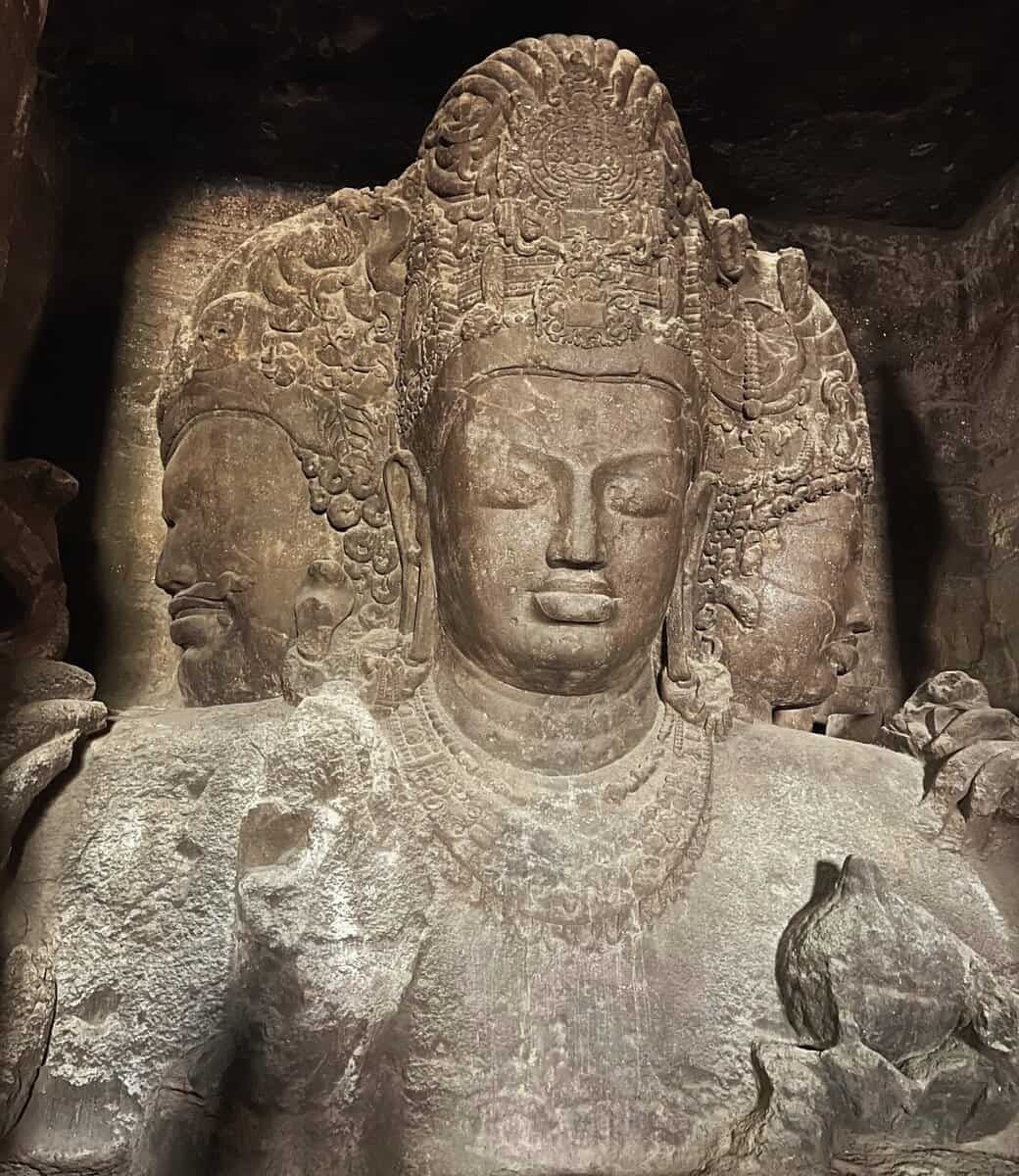
Elephanta’s most recognisable image is the monumental three-faced representation commonly known as the Trimurti or Sadashiva.
It dominates one of the principal sections of Cave 1.
The sculpture represents multiple aspects of Shiva within a single monumental form.
Its importance comes not only from its size but also from the remarkable calm and balance of the composition.
First-time visitors often walk directly towards it for a photograph.
Instead, stand back for a moment.
Observe the three faces.
Look at the differences in expression.
Then move closer.
The sculpture becomes far more interesting when viewed slowly rather than simply treated as the cave’s obligatory photo stop.
Look Beyond the Trimurti
One of the biggest mistakes first-time visitors make is focusing exclusively on the Trimurti.
Cave 1 contains several other important sculptural compositions.
Look for representations associated with:
Ardhanarishvara
A composite form bringing together masculine and feminine aspects.
Nataraja
Shiva represented through cosmic dance and movement.
Gangadhara
A composition connected with the descent of the sacred River Ganga.
Kalyanasundara
A representation associated with the marriage of Shiva and Parvati.
Ravana and Mount Kailasa
A dramatic narrative composition involving Ravana and Shiva’s sacred mountain.
These works reveal how varied the visual language of Elephanta actually is.
Some sculptures communicate stillness.
Others suggest movement.
Some focus on balance and union.
Others portray power and dramatic mythological events.
The Shiva Linga Shrine
At the centre of the Great Cave is a shrine containing a Shiva linga.
Its presence is an important reminder that Elephanta should not be approached only as an archaeological museum.
The caves have deep religious significance.
Visitors should move through the site respectfully and follow monument rules and instructions.
Understanding the sacred context also helps explain why the architecture and sculptures are arranged as they are.
What Is the Walk Like at Elephanta?
This is one of the most important practical questions for visitors.
After reaching Elephanta Island, travellers continue from the jetty towards the base of the hill.
The approach to the caves involves walking and an ascent with steps.
For many travellers this is perfectly manageable.
However, it deserves consideration for:
- senior travellers
- guests with knee difficulties
- travellers with limited mobility
- very young children
- visitors uncomfortable with prolonged walking
- anyone travelling during particularly hot weather
Do not assume that Elephanta is a completely step-free sightseeing experience.
If mobility is a concern, discuss it before the day of travel.
Is Elephanta Suitable for Senior Travellers?
Many senior travellers visit Elephanta successfully.
The important factor is individual mobility rather than age alone.
Someone who regularly walks and handles steps may find the visit straightforward.
Another traveller may require a slower pace or additional assistance.
When planning for senior guests, consider:
- walking ability
- knee or joint concerns
- heat
- hydration
- rest breaks
- the island ascent
- available assistance
A well-paced visit is far more enjoyable than trying to follow a schedule designed for faster walkers.
What Should You Wear?
Elephanta is best visited in comfortable clothing suitable for walking.
The most important item is footwear.
Choose shoes with a secure grip that you can comfortably wear for the island approach and steps.
Depending on the season, you may also want:
- light breathable clothing
- sun protection
- hat or cap
- water
- sunglasses
- a light rain layer during unsettled weather
The caves themselves can feel very different from the outdoor island environment, so comfort and practicality are more useful than formal clothing.
When Should You Visit?
For many travellers, earlier visits are preferable.
Starting earlier can provide more comfortable walking conditions and allows greater flexibility during the rest of the day.
Weather, marine operations and seasonal conditions should also be considered when planning any journey to an island destination.
If Elephanta is an important part of your Mumbai itinerary, avoid leaving arrangements until the final morning.
Are Elephanta Caves Closed on Monday?
Yes.
Elephanta Caves are closed to visitors on Mondays.
This is particularly important for international travellers spending only a short time in Mumbai.
If your itinerary includes Sunday and Monday, for example, plan Elephanta for Sunday and keep Mumbai city sightseeing for Monday.
Always reconfirm current operating conditions before your visit.
How Much Time Should You Allow?
How long you need depends largely on your interests and pace.
Visitors who simply want to see Cave 1 and the principal sculptures will naturally spend less time than travellers interested in mythology, architecture or photography.
Allow time for:
- reaching the island
- walking from the jetty
- ascending towards the caves
- exploring Cave 1
- understanding the principal sculptures
- rest stops
- returning to Mumbai
Elephanta works best as a thoughtful half-day cultural experience rather than a rushed photo stop.
Should You Visit With a Guide?
A guide is not essential simply to enter Elephanta Caves.
However, interpretation can make a substantial difference.
Without context, visitors may see an impressive collection of carvings.
With context, the sculptures become stories and ideas.
A knowledgeable guide can explain:
- the forms of Shiva represented
- the mythology behind the panels
- architectural details
- symbolism
- historical background
- the relationship between different sculptures
This is particularly useful for visitors encountering Hindu iconography for the first time.
Photography at Elephanta
Elephanta offers interesting opportunities for heritage photography.
The combination of:
- harbour views
- island landscape
- pathways
- cave architecture
- stone columns
- sculptures
- natural light and shadow
provides considerably more variety than simply photographing the Trimurti.
Always follow the current photography rules displayed at the monument.
Avoid touching carvings or interfering with other visitors simply to create a photograph.
Heritage preservation comes first.
Travelling With Children
Elephanta can be fascinating for families when children are given some context before visiting.
Instead of describing it only as an archaeological site, introduce the journey as a combination of:
- island adventure
- ancient cave architecture
- monumental sculptures
- mythology
- harbour travel
- exploration
Stories connected to Shiva and the sculptures can make the experience more engaging for younger visitors.
Parents should still consider walking distance, weather and the child’s ability to manage steps.
What Should You Carry?
Keep what you carry practical.
Useful items may include:
- water
- sun protection
- comfortable footwear
- phone or camera
- small bag
- any personal medication
- light weather protection when required
Avoid carrying unnecessarily heavy luggage.
The more comfortable you are walking, the easier it becomes to concentrate on the monument itself.
What Not to Do at Elephanta Caves
A few simple decisions make the experience better for everyone.
Avoid:
- touching sculptures
- climbing protected structures
- rushing through Cave 1
- blocking pathways for photographs
- ignoring monument instructions
- leaving litter
- feeding or approaching animals unnecessarily
- visiting without considering the walking involved
Elephanta is a protected cultural monument.
Treating it with respect should be part of the experience.
How Do You Reach Elephanta Island?
The traditional public option is by passenger ferry from the Gateway of India area in Mumbai.
Maharashtra Tourism describes the public ferry journey as taking approximately one hour.
Travellers can also choose privately coordinated marine arrangements depending on their preferred level of privacy, schedule and comfort.
If your priority is a privately managed journey rather than the public ferry experience, see our Private Elephanta Caves Speedboat Tour from Mumbai.
Details about private transport, inclusions and booking should remain on that dedicated experience page rather than this visitor guide.
Can Elephanta Be Combined With Other Mumbai Sightseeing?
Yes.
Because the journey traditionally begins and ends around South Mumbai, Elephanta can work particularly well with nearby cultural and heritage experiences.
Depending on available time, travellers may combine Elephanta with areas such as:
- Gateway of India
- Colaba
- Kala Ghoda
- South Mumbai heritage districts
- museums
- lunch in South Mumbai
Avoid trying to fit too many attractions into the same day.
Elephanta is more rewarding when enough time is allowed to enjoy the island without constantly checking the clock.
Frequently Asked Questions
Where are Elephanta Caves?
Elephanta Caves are located on Elephanta Island, historically known as Gharapuri, in Mumbai Harbour.
Is Elephanta Caves a UNESCO World Heritage Site?
Yes. Elephanta Caves has been inscribed on the UNESCO World Heritage List since 1987.
What is the most famous sculpture at Elephanta?
The monumental three-faced Sadashiva, widely known as the Trimurti, is the site’s most recognisable sculpture.
Which cave should first-time visitors see?
Cave 1, or the Great Cave, contains the site’s principal monumental sculptures and is the main focus for most visitors.
Are Elephanta Caves closed on Mondays?
Yes. Visitors should plan their itinerary accordingly and reconfirm operating information before travelling.
Is there walking involved?
Yes. Visitors should expect walking and an ascent from the island arrival area towards the caves.
Can senior travellers visit Elephanta?
Many can, but individual mobility should be considered in advance because the approach involves walking and steps.
Do I need a guide?
A guide is not compulsory, but cultural and mythological interpretation can make the cave sculptures considerably easier to understand.
How should I travel to Elephanta?
Public ferry services are the traditional option. Private arrangements are also available for travellers looking for greater privacy and personalised coordination.
A Better Way to Experience Elephanta
Elephanta rewards travellers who arrive with curiosity rather than a checklist.
Spend time inside Cave 1.
Look beyond the famous Trimurti.
Notice the columns.
Observe the smaller figures surrounding the monumental sculptures.
Listen to the stories behind what you are seeing.
Allow enough time for the island approach.
And plan around the walking rather than treating it as an afterthought.
The difference between simply seeing Elephanta and genuinely experiencing it often comes down to context, pacing and preparation.
For travellers seeking a privately coordinated journey from Mumbai, Passport Lifestyles also offers a Private Tour Elephanta Caves Speedboat Tour from Mumbai.