A short distance from modern Mumbai lies an island whose story reaches back many centuries before the city’s present skyline existed.
Today, most visitors know it as Elephanta Island.
Historically, however, the island is known as Gharapuri a landscape of hills, archaeological remains, rock-cut shrines and monumental sacred sculpture.
At its heart are the Elephanta Caves, one of India’s remarkable surviving examples of rock-cut architecture.
The caves are often introduced through their famous three-faced image of Shiva, but their importance extends far beyond a single sculpture.
To appreciate Elephanta properly, it helps to understand the island itself, the way the caves were created, the architectural thinking behind Cave 1 and why the site became part of the UNESCO World Heritage List.
This guide explores that larger story.
Gharapuri Before Modern Mumbai
Elephanta Island is also known as the Island of Gharapuri.
Its history does not begin with tourism or even with the construction of the principal caves.
UNESCO notes that archaeological evidence on the island indicates human occupation dating back as early as the 2nd century BC, showing that Gharapuri possessed a cultural history long before the monumental cave complex reached its mature form.
This is an important perspective for visitors.
Elephanta should not be understood simply as an isolated group of sculptures.
It developed within an island landscape that had already witnessed generations of human activity.
Ancient remains distributed across the island provide evidence of a much longer story.
When Were the Elephanta Caves Created?
Dating ancient monuments precisely can be difficult, especially when surviving inscriptions or historical records are limited.
UNESCO broadly dates the principal rock-cut Elephanta Caves to around the mid-5th to 6th centuries AD.
That places their creation within an extraordinary period of artistic and religious development in the Indian subcontinent.
Rather than constructing the principal temple from blocks of stone, craftsmen excavated into the existing basalt rock.
Material had to be removed carefully to create:
columns,
chambers,
sculptural panels,
shrines,
passageways,
and architectural spaces.
The process is fundamentally different from conventional building.
In rock-cut architecture, the monument gradually emerges by taking material away.
Why Is It Called Elephanta Island?
The historic identity of the island is Gharapuri.
The name Elephanta came later and is traditionally associated with a large stone elephant sculpture encountered during the Portuguese period.
The European name eventually became widely used for both the island and the caves.
Yet Gharapuri remains important because it connects the modern visitor with the island’s earlier identity.
Today both names are commonly encountered:
Elephanta Island in international tourism,
and Gharapuri in historical and local contexts.
Understanding both names helps reveal how layers of history have accumulated around the destination.
What Is Rock-Cut Architecture?
Rock-cut architecture is exactly what the term suggests:
architectural space created by excavating directly into natural rock.
The concept sounds simple.
The execution is anything but.
In a conventional building, architects and craftsmen generally assemble material.
Stone is quarried.
Blocks are transported.
Columns are erected.
Walls are constructed.
At Elephanta, much of the process worked in the opposite direction.
Craftsmen began with the existing rock mass and removed material until halls, columns, shrines and monumental sculptural compositions emerged.
That requires a remarkable understanding of space.
Once too much rock has been removed, it cannot simply be put back.
Every column must retain enough structural mass.
Every sculptural surface must relate to the surrounding architecture.
Every chamber must emerge from the same geological body.
This is one reason Elephanta is as important architecturally as it is artistically.
Cave 1: The Great Cave
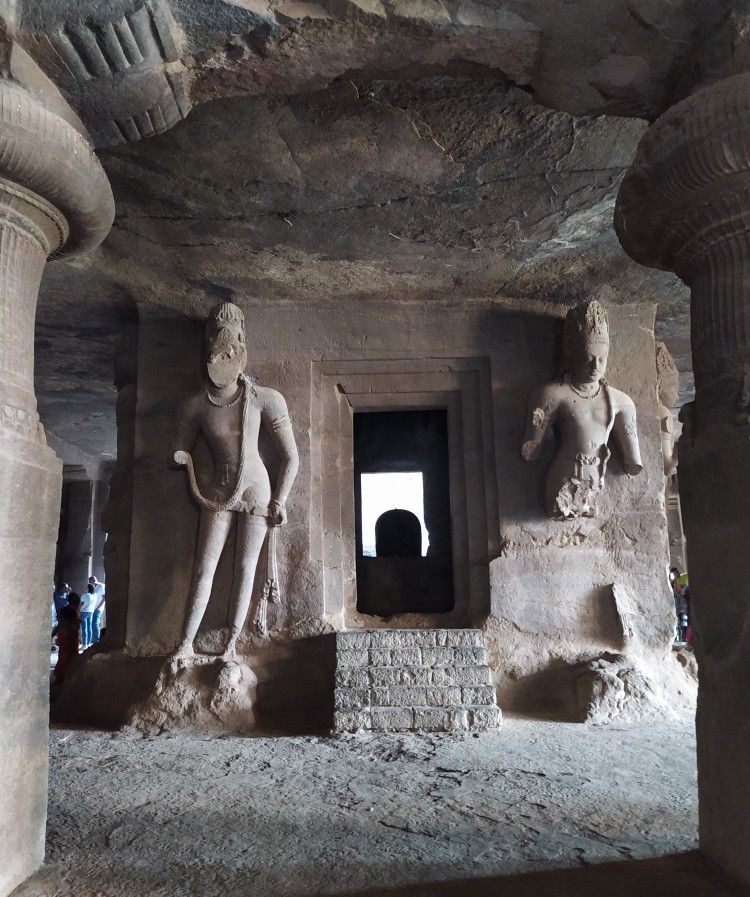
The most significant part of the complex is Cave 1, commonly called the Great Cave.
UNESCO records the cave as extending approximately 39 metres from its front entrance to the rear.
The main body of the cave is around 27 metres square, excluding the porticos and rear aisle, and is organised through rows of substantial stone columns.
But numbers alone do not explain the effect.
Entering Cave 1 creates an immediate change in atmosphere.
Outside is an island landscape.
Inside is a monumental stone interior shaped by rhythm, symmetry, shadow and mass.
Rows of columns lead the eye through the space.
Sculptural panels occupy carefully selected positions.
A shrine forms a spiritual focus.
Everything feels connected.
That integration is fundamental to the cave’s design.
Architecture and Sculpture Were Conceived Together
One of the most interesting characteristics of Elephanta is that its sculptures do not simply decorate the architecture.
They participate in it.
Large relief panels are positioned in relation to entrances, columns, circulation and the central sacred space.
This means visitors should avoid thinking of the cave as a museum where artworks have simply been placed along walls.
The architecture establishes how the sculptures are encountered.
A figure may appear gradually as you pass between columns.
Another may dominate an entire visual axis.
Natural light may reveal one surface while leaving another in shadow.
Movement through the cave therefore becomes part of the experience.
The Central Shrine
Within the Great Cave is a shrine associated with Shiva.
Its presence is essential to understanding the monument.
Elephanta is not merely a collection of historic carvings.
It is a sacred architectural environment.
The shrine, monumental reliefs and surrounding space form a connected religious and artistic programme.
Observe how the shrine can be approached from different directions.
Notice how circulation around it influences your view of the cave.
That relationship between sacred function and architectural organisation is one of the most important features of the site.
Shiva at the Centre of Elephanta
The principal sculptural programme of Cave 1 is closely connected with Shiva.
UNESCO describes the cave’s major reliefs as one of the most important surviving collections associated with the cult of Shiva.
Different representations explore contrasting aspects of the deity.
Movement.
Meditation.
Marriage.
Power.
Balance.
Cosmic identity.
Transformation.
The result is not a simple sequence of decorative scenes.
It is a sophisticated visual programme in which different dimensions of Shiva occupy one architectural environment.
The Monumental Sadashiva
The image most closely associated with Elephanta is the monumental three-faced Sadashiva, widely known as the Trimurti.
UNESCO describes it as approximately seven metres high and identifies the three faces with different aspects of Shiva.
Its position gives it immense visual presence.
Yet its impact comes from more than scale.
There is a striking sense of stillness in the central face.
The surrounding forms communicate contrasting qualities while remaining part of one composition.
The sculpture has become a visual symbol of Elephanta, but it should be experienced as part of the wider architectural programme rather than in isolation.
For a detailed explanation of this and the other monumental reliefs, read our:
Elephanta Caves Sculptures & Trimurti Guide
That dedicated article explores the individual sculptures in greater depth.
Other Monumental Reliefs
Around Cave 1 are other important representations associated with Shiva.
UNESCO highlights works including:
Nataraja,
Yogishvara,
Ardhanarishvara,
Kalyanasundaramurti,
Gangadharamurti,
Andhakasuravadha,
and Ravanaanugrahamurti.
Each contributes to the broader visual and spiritual character of the cave.
Their placement, scale and relationship to the architecture are part of what makes Elephanta exceptional.
The site therefore rewards visitors who look beyond the best-known image.
Why the Columns Matter
Visitors naturally focus on sculpture, but the columns of Cave 1 deserve attention as well.
They organise the space.
They establish rhythm.
They frame views.
They help divide the interior without completely separating it.
As you move through the cave, look at how columns repeatedly create and then reveal new perspectives.
This architectural rhythm gives the interior a ceremonial quality.
The cave feels organised without feeling confined.
That balance between openness and structure is an important part of the design.
Light Is Part of the Architecture
Rock-cut monuments change dramatically depending on light.
Elephanta is no exception.
The cave’s openings allow natural daylight to penetrate the interior unevenly.
As a result, some surfaces become clearly visible while others remain partially in shadow.
Sculptures can appear different depending on where you stand.
Details emerge gradually.
Columns create silhouettes.
The contrast between the bright island exterior and darker cave interior adds to the sense of transition.
Visitors who rush through often miss this aspect completely.
Spend time watching the cave rather than simply moving from sculpture to sculpture.
The Relationship With Ellora
UNESCO notes architectural similarities between Elephanta’s Great Cave and the Dumar Lena cave at Ellora.
This connection places Elephanta within a much broader tradition of Indian rock-cut architecture.
Western India contains some of the world’s most important rock-cut monuments, including major complexes at Ajanta, Ellora and elsewhere in Maharashtra.
Elephanta belongs to that wider architectural story while maintaining its own distinctive identity.
For travellers exploring Maharashtra beyond Mumbai, this connection can make visits to other cave complexes even more meaningful.
Why Elephanta Became a UNESCO World Heritage Site
Elephanta Caves was inscribed on the UNESCO World Heritage List in 1987.
UNESCO recognises the caves under criteria relating to their extraordinary artistic achievement and importance within western Indian rock-cut architecture.
The organisation specifically highlights the monumental reliefs surrounding the shrine in Cave 1 and the architectural achievement of the complex.
In other words, Elephanta’s importance comes from the combination of:
art,
architecture,
religious symbolism,
craftsmanship,
and historic context.
No single element explains the site on its own.
Elephanta Is More Than One Cave
The Great Cave receives most visitor attention, and understandably so.
However, the archaeological landscape of Elephanta extends beyond one chamber.
UNESCO describes the island as containing multiple archaeological remains across two hillocks separated by a valley.
This wider setting matters.
The caves exist as part of an island landscape shaped by occupation, religious activity and historical change.
Thinking about Elephanta at island scale rather than as a single monument creates a more complete understanding of the place.
What Happened to Elephanta Over the Centuries?
Like many ancient monuments, Elephanta has passed through periods of political change, changing use, environmental exposure and physical deterioration.
Today visitors can clearly see that some sculptures have suffered damage.
Yet much of the essential architectural and artistic character survives.
UNESCO notes that the archaeological components continue to be preserved within their natural setting and also identifies conservation challenges, including deterioration affecting rock surfaces.
The visible marks of age should therefore be understood as part of the site’s long history.
Elephanta has not been frozen in time.
It has survived time.
Why Conservation Matters
Rock-cut architecture cannot simply be reconstructed like a modern building.
The monument and natural rock are intimately connected.
Environmental conditions, moisture, salt activity, human contact and long-term geological processes can all affect historic stone.
Responsible conservation therefore requires careful management.
Visitors contribute to preservation through simple behaviour:
respect barriers,
avoid touching vulnerable surfaces,
follow monument rules,
do not scratch or mark stone,
and treat the caves as heritage rather than a backdrop.
The monument has survived for centuries.
Responsible tourism helps extend that story.
How to Experience the Architecture Properly
Most visitors naturally enter Cave 1 and immediately search for the famous Trimurti.
Try doing something different.
Pause near the entrance.
Look at the overall volume of the space.
Notice the columns before the sculptures.
Observe where the shrine sits.
Watch how other visitors move around the cave.
Then begin exploring the reliefs.
This sequence helps you understand that the sculptures belong to an architectural composition.
Elephanta becomes considerably richer once you stop seeing it as a collection of separate attractions.
Visit With Context
A knowledgeable heritage guide can be particularly useful at a monument such as Elephanta.
Dates alone are not enough.
What makes the site interesting is understanding relationships:
between Shiva’s different forms,
between sculpture and architecture,
between the shrine and surrounding reliefs,
between Gharapuri’s landscape and the caves,
and between Elephanta and the wider tradition of Indian rock-cut architecture.
Good interpretation turns physical remains into a story.
Planning Your Visit
History is easier to appreciate when practical arrangements do not dominate the day.
Before visiting, consider weather, walking requirements, footwear, hydration and mobility.
For practical preparation rather than historical background, read:
Elephanta Caves Visitor Tips: What to Wear, Carry & Expect
Keeping visitor preparation on its dedicated page prevents this history article from becoming another general-purpose Elephanta guide.
Understanding the Harbour Setting
The island’s position within Mumbai Harbour is also part of the experience.
Travelling away from South Mumbai creates a gradual transition from modern cityscape to historic island landscape.
For more about that geographical journey, read:
Mumbai Harbour to Elephanta Island: Route & Landmarks Guide
This article remains focused on Elephanta’s history and architecture rather than transport.
Frequently Asked Questions About Elephanta Caves History
What is the historical name of Elephanta Island?
The island is historically known as Gharapuri.
How old are the Elephanta Caves?
UNESCO broadly dates the principal rock-cut caves to around the mid-5th to 6th centuries AD.
Was the island inhabited before the caves were created?
Archaeological remains indicate activity on the island dating back much earlier, with UNESCO noting evidence from as early as the 2nd century BC.
What type of architecture is Elephanta?
Elephanta is a major example of Indian rock-cut architecture, in which architectural spaces and sculptures were excavated directly from natural rock.
Which is the most important cave?
Cave 1, also called the Great Cave, is the most significant and contains the site’s principal monumental Shiva reliefs.
What is the Trimurti at Elephanta?
The monumental three-faced Sadashiva, often called the Trimurti, is the best-known sculpture within Cave 1.
When did Elephanta become a UNESCO World Heritage Site?
The Elephanta Caves were inscribed on the UNESCO World Heritage List in 1987.
Is Elephanta only important for its sculptures?
No. Its architectural planning, shrine, columns, rock-cut engineering, island setting and wider archaeological remains are also fundamental to its significance.
From Ancient Gharapuri to Modern Mumbai
Few experiences reveal Mumbai’s historical depth as dramatically as Elephanta.
In one direction lies a modern global metropolis.
Across the harbour lies an island whose archaeological record stretches back far beyond the present cityscape.
Inside its hills, generations of craftsmen transformed basalt into architecture.
Columns emerged from stone.
Shrines took shape.
Monumental reliefs appeared across the cave walls.
And the resulting complex became one of western India’s remarkable surviving achievements in rock-cut architecture.
Understanding that history changes the experience.
You no longer visit Elephanta simply to see an old cave.
You begin to recognise Gharapuri as a cultural landscape shaped by centuries of human imagination, spiritual thought and extraordinary craftsmanship.
Continue Your Elephanta Journey
If your interest is the art inside Cave 1, continue with our Elephanta Caves Sculptures & Trimurti Guide.
If you are preparing for the physical visit, use our Elephanta Caves Visitor Tips & Checklist.
And if you are specifically looking for a privately coordinated journey from Mumbai with marine transport, guiding and ground arrangements, visit our dedicated:
Private Elephanta Caves Speedboat Tour from Mumbai
That dedicated product page should remain the source for private-speedboat details, inclusions and booking.
This history article exists for a different reason:
to explain why Elephanta is worth reaching in the first place.